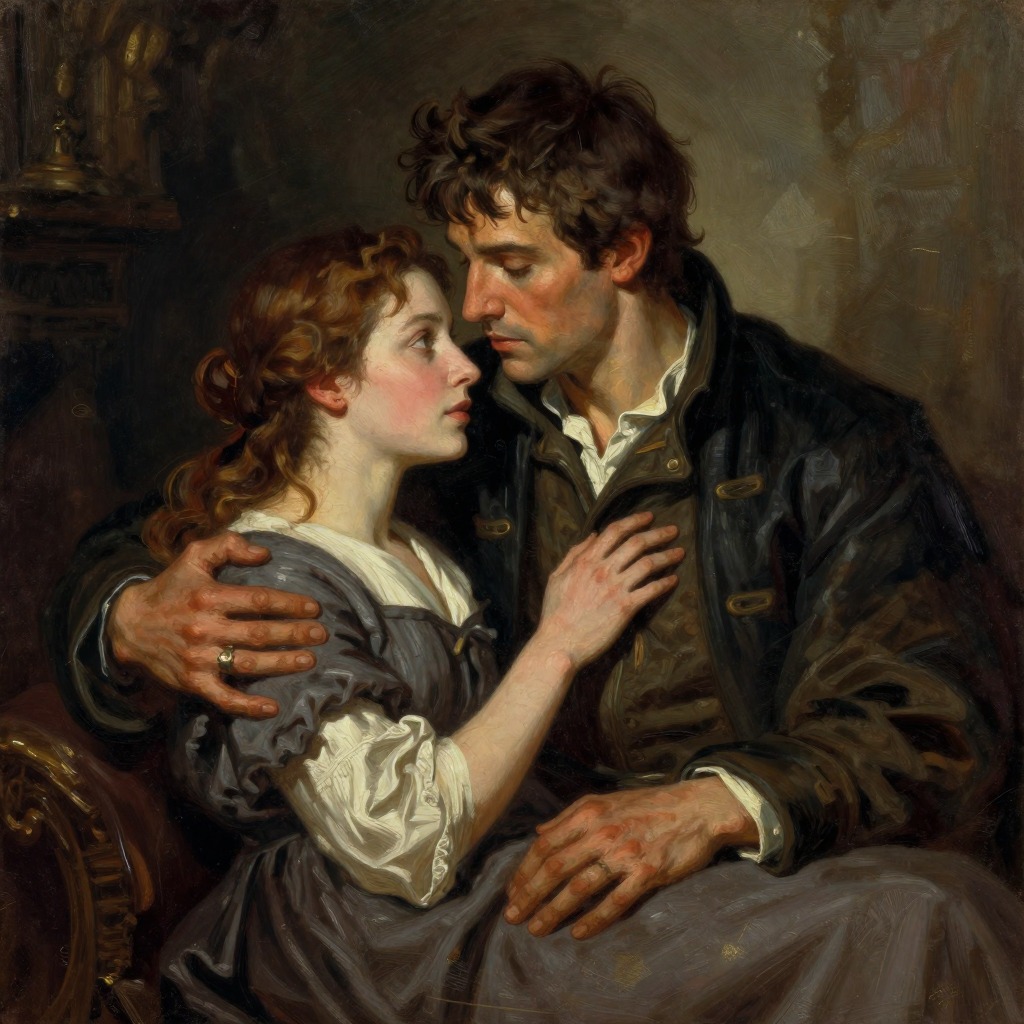
Family evening routine
The family evening routine in Nathaniel's childhood home is a fixed domestic ritual that becomes the stage for his earliest and most formative encounters with the figure he later identifies as the Sandman, Coppelius. This nightly pattern, described in Nathaniel's first letter to Lothar, establishes the atmosphere of mystery, paternal authority, and maternal anxiety that pervades his early memories and sets the psychological groundwork for his lifelong terror.
Structure and Atmosphere of the Evening
Except at lunchtime, Nathaniel and his siblings saw little of their father during the day, as he was evidently very busy. After supper, served at seven o'clock according to long-standing custom, the entire family—Nathaniel, his siblings, and his mother—gathered in the father's study and took their places at a round table. The father smoked a pipe and drank a tall glass of beer. On some evenings he told the children wondrous tales, becoming so absorbed that his pipe went out, and it was Nathaniel's duty to fetch a burning wad of paper to relight it—a task that gave the boy the greatest pleasure. On other evenings the father simply gave the children picture books to look at and sat in silence, propped in his easy chair, blowing dense clouds of smoke until the family seemed to hover in a fog. During these silent evenings the mother was very sad.
The Sandman's Cue and the Children's Dismissal
No sooner did the clock strike nine than the mother would declare, "Now children, to bed! To bed with you! The Sandman's coming, I can sense it!" Every time she said this, Nathaniel really did hear the sound of slow, heavy steps lumbering up the stairs—steps he believed must belong to the Sandman. The mother's warning was the fixed signal that ended the evening gathering, and the children were led away to bed. When Nathaniel once asked his mother who the evil Sandman was, she replied that there was no Sandman, that the phrase only meant the children were sleepy and could not keep their eyes open, as if someone had scattered sand in them. But this answer did not satisfy him, and the notion took firm hold of his childish imagination that his mother only denied the Sandman's existence to keep them from being afraid—after all, he had heard the steps with his own ears.
The Nanny's Tale and the Deepening of Fear
Driven by a burning desire to know more, Nathaniel asked the old woman who took care of his youngest sister about the Sandman. She told him that the Sandman was a bad man who came to children who would not go to sleep, flung a handful of sand in their eyes so they scratched themselves bloody, then flung them in his bag and carried them off to the half-moon to feed his children, who sat up there in their nest with crooked beaks like owls and picked out the eyes of naughty human brats. This grim picture took hold of Nathaniel's mind; as soon as he heard the lumbering step on the stairs he trembled with fear and horror. His mother could get nothing out of him but the stuttered word "Sandman! Sandman!" and he would bound up to his bedroom, tormented all night by the terrible presence.
Persistence of the Ritual and Nathaniel's Growing Curiosity
Even after Nathaniel grew old enough to know that the nanny's story could not possibly be true, the Sandman remained entrenched in his mind as a hair-raising spook. He was gripped by dread and terror when he heard the figure not only climb the steps but tear open the door to his father's study and barge in. Sometimes the Sandman stayed away a long time, but then he came more often, night after night, for years. Nathaniel was never able to get used to the ghastly spook, nor did the grisly image ever fade. The desire to see the fabled Sandman with his own eyes grew stronger year by year, and the Sandman lured him down the path of wonder and adventure that had already taken seed in his childish mind. He liked nothing better than to hear or read fear-tingling tales of goblins, witches, and sprites, but the Sandman remained at the head of his list of grisly figures, which he scribbled with chalk and charcoal on table tops, cupboards, and walls.
The Night of Revelation
When Nathaniel turned ten, his mother moved him from the nursery into a little room off the corridor not far from his father's study. The family still had to make themselves scarce at the strike of nine, when the unseen presence was heard in the house. From his little room Nathaniel distinctly heard the figure enter his father's chamber, and soon thereafter it seemed as if the entire house filled with a strange-smelling vapor. His ever-mounting curiosity stirred his pluck to try to find a way to make the Sandman's acquaintance. Many times he slipped out into the corridor as soon as his mother had passed, but he was always too late. Finally, driven by an overpowering urge, he decided to hide in his father's room and await the Sandman's appearance. One evening, by his father's silence and his mother's sadness, he surmised that the Sandman was coming. Pretending to be very tired, he excused himself before nine o'clock and hid in a nook beside his father's door. The front door creaked, the slow, heavy thud of steps advanced through the vestibule towards the stairs. His mother hastened by with his brothers and sisters. Quietly he opened his father's door and slipped in behind the curtain drawn over a closet. Closer came the thud of the steps, with a curious cough and a scraping and a grumbling outside. A powerful kick and a hefty blow on the latch sent the door springing open with a crash. Peeking out with great trepidation, Nathaniel saw the Sandman standing in the middle of the room in front of his father: the old barrister Coppelius, who sometimes dined with them for lunch. This revelation transformed the Sandman from a fairy-tale bogeyman into a hideous, ghastly fiend who brought misery and ruin wherever he appeared.
Significance
The family evening routine is the narrative crucible in which Nathaniel's childhood fear of the Sandman is forged and sustained. The fixed pattern of the father's storytelling or silent smoking, the mother's sad warning at nine o'clock, and the children's enforced departure create a ritualized space of mystery and dread. The routine's regularity makes the Sandman's appearance predictable yet terrifying, and it is within this framework that Nathaniel's curiosity drives him to break the rule and hide, leading to the traumatic revelation that the Sandman is Coppelius. The evening routine thus functions as both a domestic structure of order and the stage for the intrusion of the uncanny into Nathaniel's life.